
You stand in front of your Lake Mary kitchen cabinets and you can see the math. Two days of priming, sanding, then topcoat, then cure time. Or one weekend with a “paint and primer in one” product and the cabinets repainted by Sunday night. The shorter timeline is tempting, especially when the marketing on the can promises premium adhesion without the prep work.
The honest answer is that the shortcut almost never works on cabinets. Self-priming paints can perform reasonably well on walls in similar color changes, but cabinet surfaces have factory finishes, grease buildup, tannin bleed, and Central Florida humidity working against them in ways that walls do not. The shortcut that saves a day at the start of the project usually costs a complete redo within 12 months.
This guide breaks down when cabinet paint without primer is technically defensible, when it absolutely is not, and how to think through the decision for your specific Lake Mary kitchen.
Key Takeaways
- Professional cabinet painters rarely skip primer on kitchen projects regardless of what self-priming paint products claim.
- Paint-and-primer-in-one products work for walls in similar color changes, not for high-touch cabinet surfaces.
- Adhesion failures typically appear 3 to 12 months after application and require a complete redo to fix.
- Central Florida humidity makes proper primer selection significantly more important than in drier climates.
- Raw wood, glossy factory finishes, laminate, and previously stained cabinets always require separate primer.
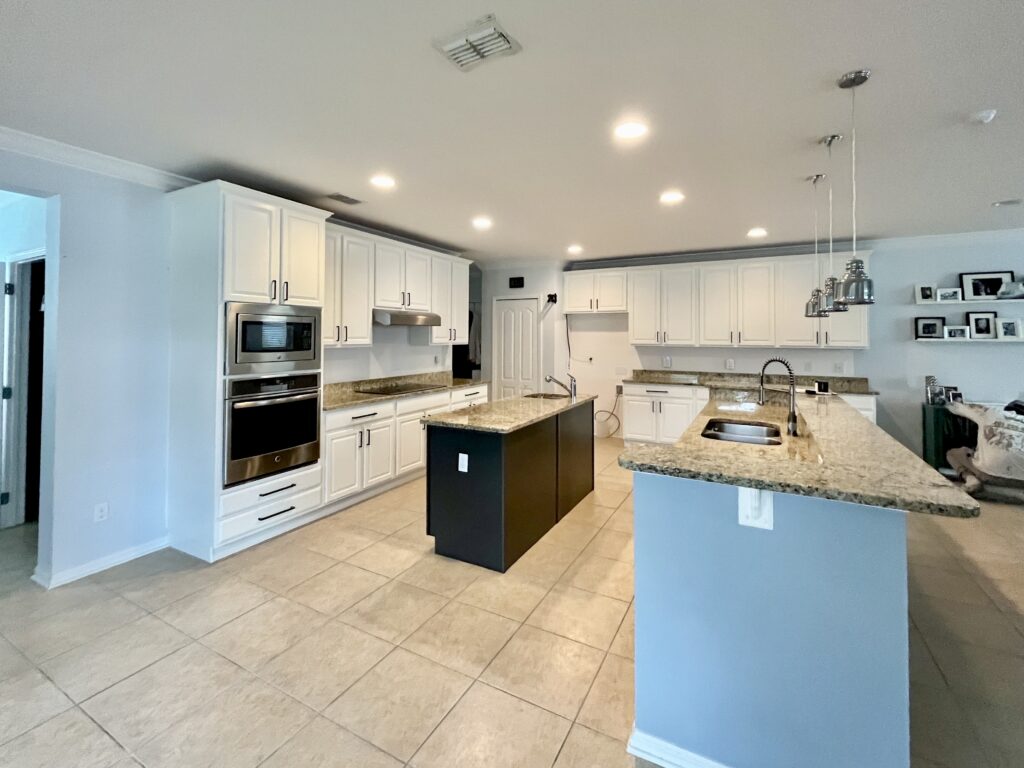
Can You Use Cabinet Paint Without Primer? The Honest Answer
The short version answers the question directly. The longer version explains why the short version matters more in Lake Mary than in drier markets.
The Short Answer
You can technically apply cabinet paint without primer in narrow circumstances. You should not in almost any real Lake Mary kitchen scenario, because the conditions that make self-priming paints work on walls do not apply to cabinets.
Factory finishes, cooking residue, tannin bleed, and Central Florida humidity are the four conditions that defeat primer-free cabinet jobs almost every time.
Why the Question Comes Up
Paint manufacturers have made paint-and-primer-in-one products sound like the perfect time-saver. Some products contain higher solids and improved adhesion agents compared to standard paint.
For a homeowner planning a weekend cabinet refresh, the idea of cutting out the primer step looks like a clean win on time and money. The reality is more nuanced than the marketing suggests.
When Paint-and-Primer-in-One Actually Works
Self-priming paints have a legitimate use case. It is narrow, and it does not include most cabinet projects.
The Right Use Case
Self-priming paints work best for changing colours over previously primed and painted latex surfaces. The actual benefit of these products is improved one-coat coverage on a stable substrate, not the ability to bond to bare wood, glossy surfaces, or contaminated cabinets.
The conditions that make self-priming paint work well are: previously painted surface in good condition, similar colour change rather than dramatic shift, clean substrate with no grease, and a low-wear surface like an interior wall.
Where They Fail
Most wood finishes including cabinets are not suitable for paint-and-primer-in-one application. Wood surfaces need the extra adhesion that traditional primer delivers, plus stain blocking that self-priming paints rarely provide.
For the broader product comparison on what actually holds up on Lake Mary cabinets, see our guide on best cabinet paint brands that last.
Why Cabinet Surfaces Defeat Primer-Free Paint
Three specific conditions make cabinet surfaces fundamentally different from walls, and each one is enough on its own to defeat painting cabinets without primer.
Glossy Factory Finishes
Factory cabinet finishes are typically semi-gloss or gloss, which resist paint adhesion by design. Glossy surfaces give paint nothing to grip without proper surface profiling and a bonding primer.
Doors, drawers, and trim with shiny factory finishes need a primer specifically engineered for slick surfaces. Without it, even premium topcoat peels off the gloss within months.
Grease and Cooking Residue
Years of cooking create an invisible film of oils, cooking residue, and silicone polishes that repel paint at the molecular level. Cabinets near the cooktop are the worst offenders, but every cabinet in a working kitchen has some level of contamination.
Without thorough degreasing followed by primer, the paint never bonds to the cabinet itself; it bonds to the contamination film, which fails first.
Wood Grain and Tannin Bleed
Natural wood contains tannins that bleed through paint over time, especially in humid climates. The tannins seep through the finish and create yellow or brown discoloration that ruins the paint job even when adhesion is fine.
A stain-blocking primer is the only reliable way to prevent tannin bleed. Self-priming paints do not include stain-blocking technology at the level needed for raw or stained wood.
The Central Florida Humidity Factor
Lake Mary’s climate makes proper primer significantly more important than in most other markets in the country.
The Climate Profile
According to NOAA Central Florida climate data, the I-4 corridor including Lake Mary, Sanford, and Orlando experiences summer humidity that regularly exceeds 80% with sustained periods above 70% from May through October. That kind of persistent humidity affects how paint bonds to the substrate during application and how the bond holds up over the long term.
Cabinet paint applied without primer in Central Florida humidity often shows adhesion failure within 6 to 12 months, where the same job in a drier climate might hold for 18 to 24.
What Humidity Does to the Bond
High humidity during application slows drying, leaves paint tacky longer, and creates conditions where dirt and contamination bond to the wet surface before it cures. Post-application, ambient humidity continues to push moisture through any paint film not properly sealed by primer.
The combination of slow cure and ongoing moisture migration is what makes Lake Mary cabinet paint jobs fail faster than national averages. For deeper context on what survives in this climate, see our guide on whether are painted cabinets durable in humidity.
Specific Situations Where Primer Is Non-Negotiable
Four cabinet conditions require separate primer regardless of what the paint can label promises. Skipping primer in any of these scenarios guarantees failure.
Raw or Unfinished Wood
Raw wood, bare drywall, metal, and cement all require separate primer before topcoat. Self-priming paints cannot deliver the substrate sealing that raw materials need for the topcoat to perform.
This applies to any cabinet box, door, or drawer face where the original finish has been completely stripped or where new wood has been added during a remodel.
Dramatic Colour Changes
Going from dark to light cabinets without primer typically requires three or four coats to reach full coverage, and may still show colour inconsistencies in raking light. The cost in time and product usually exceeds what primer plus topcoat would have required.
A tinted primer in a colour close to the final topcoat is the right approach for any colour change of more than two shades.
Previously Stained Cabinets
Stained wood contains tannins that bleed through paint over time. These naturally occurring compounds seep to the surface and ruin the paint job even when adhesion is otherwise fine.
A dedicated stain-blocking primer is the only reliable way to prevent this. For why this is one of the most common failure modes Lake Mary homeowners deal with, see our guide on sticky cabinets after painting fixes.
Laminate or Thermofoil Surfaces
Laminate and thermofoil cabinet finishes are non-porous and require bonding primers specifically engineered for plastic-like substrates. Standard primer (or no primer) on laminate cabinets fails within months.
The Cost of Cutting Corners
Skipping primer often saves a few hundred dollars upfront and costs a few thousand within 18 months. The math is consistent across cabinet painting projects.
What Failure Looks Like
When cabinet paint without primer fails, it rarely fails on day one. The paint may dry and look acceptable for 3 to 12 months, then the symptoms start: chipping at the door edges, tannin staining bleeding through light colours, paint pulling away from corners, and that telltale tacky surface that never fully cures.
The Fix-It Cost
Fixing a failed cabinet paint job typically requires stripping the failing paint completely, sanding the surface properly, cleaning and degreasing thoroughly, applying correct primer, and repainting with quality cabinet paint. The full redo usually costs 50% to 80% more than doing it right the first time would have, plus the disruption of living with a kitchen in process twice.
For the proper step-by-step approach that prevents this entire situation, see our guide on how expert kitchen cabinet painters work.
Doing It Right the First Time
A proper cabinet paint job in Lake Mary takes about 5 to 7 days from start to cure. Primer is one of those days, and skipping it does not save the project a week; it costs the project its entire lifespan.
Making the Right Choice for Your Lake Mary Kitchen
Three simple questions determine whether you can defensibly skip primer on your cabinet project.
When Self-Priming Paint Might Work
Self-priming paint might be defensible if your cabinets have been painted before, the current paint is in good condition, you are doing a similar colour change, and the cabinets are low-use (a butler’s pantry, a guest bathroom, a powder room vanity). If all four conditions apply, you can probably get away with skipping separate primer.
If any one of those conditions fails, primer is the right call.
When You Need Separate Primer
Separate primer is non-negotiable for any kitchen with daily cooking use, any cabinet with a glossy factory finish, any unpainted or stained wood, any laminate or thermofoil, any dramatic colour change, and any cabinet in a Lake Mary kitchen with persistent humidity exposure.
For most Lake Mary kitchens, that list covers essentially every cabinet in the house.
Bathroom Cabinet Considerations
Bathroom cabinets face a different set of conditions: higher humidity, more frequent water contact, less grease, and typically lower use frequency. For the bathroom-specific product and prep guidance, see our guide on best paint for bathroom cabinets.
Your kitchen is one of the most-used rooms in your Lake Mary home, and Central Florida humidity does not forgive a wrong call on cabinet paint or primer. Whether you want an honest assessment of whether your cabinets need separate primer for your specific finish and project, advice on the right product for Lake Mary humidity, or a full professional repaint that holds for 7 to 10 years, our team at Cabinet Coating Kings will walk you through exactly what your kitchen needs.
Call 407-917-9535 for a FREE estimate today.
