
A paint sprayer applies coatings up to 10 times faster than a brush, which turns a multi-week cabinet project into a weekend. The catch is that the wrong sprayer, or the right sprayer used wrong, produces drips, overspray, and an uneven finish that looks worse than the brush job you were trying to avoid.
This guide breaks down the two sprayer types that matter for cabinets (HVLP and airless), the specific models that perform well for DIY, the features that actually affect finish quality, and the maintenance routine that keeps a sprayer working. It also covers the honest line where DIY stops making sense and a professional finish is the better investment.
Key Takeaways
- HVLP sprayers give more control and a finer finish, which makes them the better choice for detailed cabinet work.
- Airless sprayers cover large areas faster but require more skill to avoid runs and drips.
- A detail-finish nozzle and correct tip size are essential for a smooth cabinet surface.
- Wagner FLEXiO and Graco Magnum models dominate the DIY cabinet sprayer market.
- Thorough cleaning after every use is the single biggest factor in sprayer lifespan.
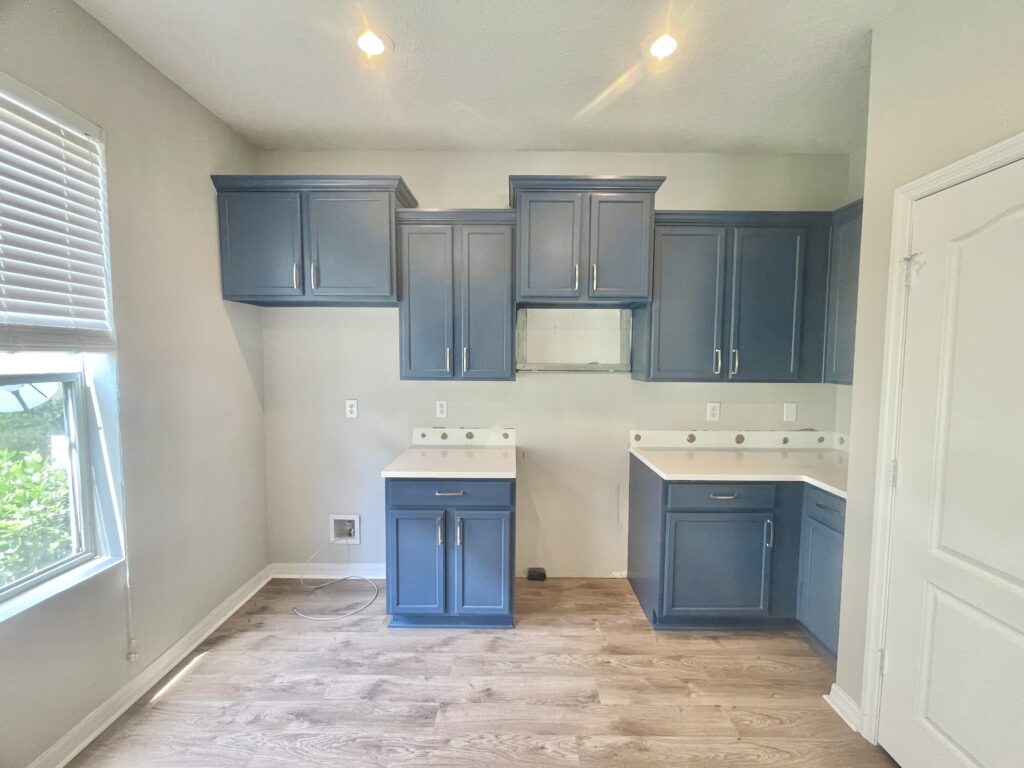
What Makes a Paint Sprayer Right for Cabinet Work
A sprayer produces a streak-free finish that brushes and rollers cannot match, which matters most on cabinets where a smooth, professional look is the whole point.
Why Cabinets Are Harder Than Walls
Cabinet doors have intricate profiles, raised panels, and tight corners that challenge most spray equipment. A good sprayer reaches the details and corners that brushes miss while keeping coverage consistent across every face.
Not every sprayer handles this precision. The same tool that coats a wall quickly can flood a raised-panel profile with runs.
The Real Frustration Behind the Project
The problem most Oviedo homeowners face is not just wanting updated cabinets. It is the frustration of brush marks, uneven coverage, and the time commitment of hand-painting dozens of doors.
You want the smooth finish that makes a kitchen look professionally done, not like a weekend project that went sideways. The right equipment is what closes that gap.
HVLP vs Airless: Which Type Serves Cabinet Projects Better
HVLP is usually the better choice for cabinets and furniture because it delivers a finer, smoother, more controlled finish than airless.
HVLP Sprayers for Precision Work
HVLP (high volume, low pressure) sprayers atomize paint with low-pressure air, producing larger, slower particles that are easier to control. That control is what makes them ideal for cabinets, doors, and trim where surface quality is critical.
HVLP strengths for cabinets: better paint distribution with less overspray waste, easier learning curve for beginners, a cleaner workspace, and superior detail on profiles and edges.
HVLP limitations: slower coverage, frequent cup refilling on large jobs, and the occasional need to thin paint.
Airless Sprayers for Speed
Airless sprayers atomize paint under high pressure, handling thicker cabinet-grade finishes straight from the can without thinning. They cut painting time by 50% to 75% compared to brushing.
Airless strengths: fastest coverage, handles heavy materials, and best for large multi-room projects.
Airless considerations: more skill required to avoid runs, less precise on fine detail and complex profiles, and higher overspray that demands more masking.
Best Paint Sprayers for Cabinets Recommendations
Best HVLP for DIY: Wagner FLEXiO 5000
The Wagner FLEXiO 5000 is widely recommended as an affordable HVLP that still produces professional results. It includes adjusters for pattern width, direction, and flow, plus a 1.5-quart paint capacity.
The Detail Finish nozzle is what makes it work for cabinets, applying a smooth, brush-mark-free finish on doors, trim, and furniture. The included iSpray nozzle handles thicker materials for broader surfaces.
The turbine sits in a separate base connected by hose, which keeps the spray gun lightweight and easier to control through a long cabinet session.
Budget Option: HomeRight Super Finish Max
The HomeRight Super Finish Max is a strong budget pick for cabinets. It features a 450-watt motor, adjustable flow and pattern controls, and a brass spray tip that handles a wide variety of paints.
For a homeowner doing one kitchen, it delivers most of the FLEXiO’s finish quality at a lower price point.
Professional-Grade Airless: Graco Magnum ProX17
For larger projects or multiple rooms, the Graco Magnum ProX17 gets cabinets as close to a factory finish as a homeowner can reach. It is a model many professionals actually use.
It delivers consistent results across big projects without the frequent maintenance stops that slow production work. The trade-off is a steeper learning curve and higher overspray.
Critical Features to Evaluate Before Buying
Spray Pattern and Nozzle Options
Match tip size to the surface. For cabinets, use a smaller fan width of 2 to 6 inches, and save the wider tips for walls and large flat panels.
Look for a sprayer that includes both a detail-finish nozzle for cabinet faces and a broader nozzle for boxes. A 311 tip outputs a 6 to 8 inch pattern for stains and sealers; a 413 tip outputs 8 to 10 inches for enamels and polyurethanes.
Flow Control and Pressure Adjustment
Thicker paints need more pressure; thinner ones need less. The ability to fine-tune these settings mid-project prevents the drips, runs, and uneven coverage that make cabinets look amateur.
Always run the lowest pressure that still produces a clean spray pattern. Lower pressure saves paint, reduces tip wear, and prolongs pump life.
Material Capacity and Refill System
For a project with 20 to 30 doors plus drawer fronts, refill frequency matters. Stopping to refill an HVLP cup repeatedly slows the job and creates lap marks at restart points.
Airless systems that draw straight from the can eliminate this interruption. HVLP systems with larger cups reduce it.
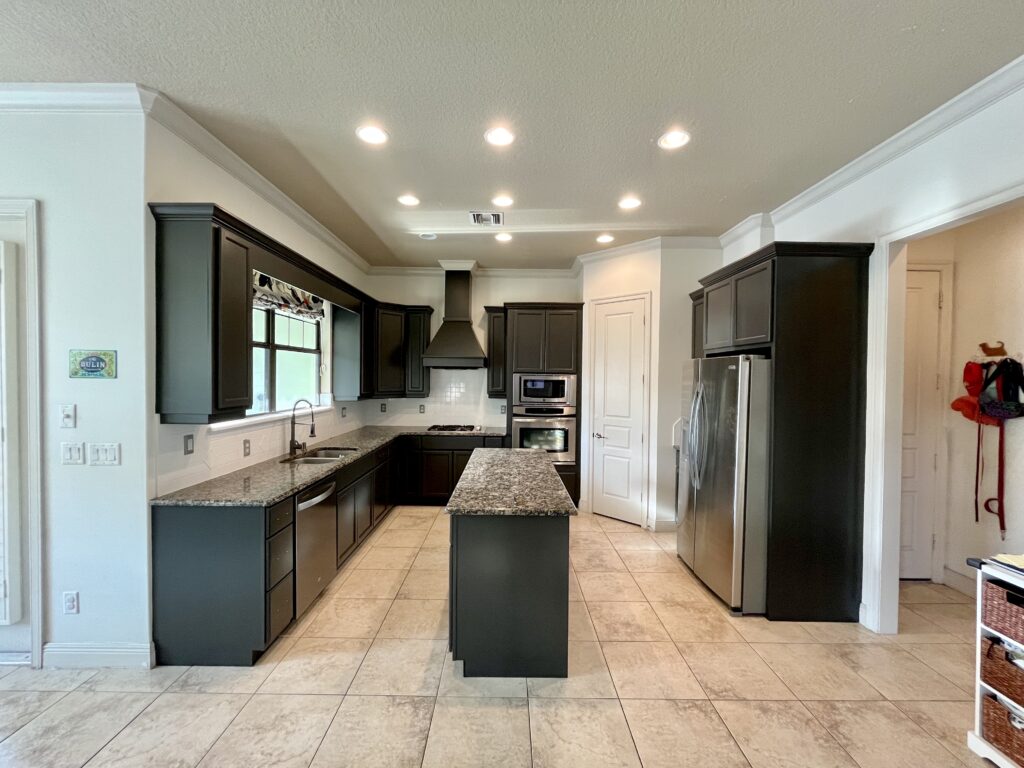
Essential Accessories and Setup Requirements
Spray Tips and Maintenance Items
Reversible “Reverse-A-Clean” tips come in roughly 200 sizes and clear clogs by turning the tip 180 degrees, without removing the guard. They are the most versatile option for varied coatings.
Stock cleaning needles, tip guards, and replacement filters before you start. Clean the intake, gun, and manifold filters after each use, since clogged filters restrict flow and cause uneven coverage.
Workspace Setup for Cabinet Spraying
Set up a dedicated spray area in a garage or covered outdoor space. A simple temporary booth made from plastic sheeting and cardboard confines overspray and limits dust movement.
Spraying releases fine paint particles and solvents into the air, so ventilation and a respirator matter. The EPA guidance on paint spraying safety covers ventilation and exposure basics worth reviewing before you start, especially in Florida’s enclosed, air-conditioned spaces.
Always test on scrap material first to confirm the spray is coming out smooth and even before you touch a cabinet door.
Maintenance and Cleaning: Protecting Your Investment
Daily Cleaning Routine
Thorough cleaning after every use prevents dried residue, which is the leading cause of sprayer failure. Flush the system with water for latex or the correct solvent for oil-based products, and clean the manifold and gun filters daily.
This routine takes 10 to 15 minutes and prevents the dead-equipment scenario where a neglected sprayer fails the next time you need it.
Storage and Long-Term Care
After cleaning, add a pump-protection fluid and store the sprayer in a clean, dry place away from temperature extremes. In Florida’s humidity, this step is critical to prevent corrosion and seal deterioration.
Lubricate moving parts with light machine oil after each day of use. Avoid over-lubricating, since excess oil can flow into paint passages and contaminate your finish.
Common Mistakes That Ruin Cabinet Finishes
Distance and Movement Errors
The most common mistake is spraying too close, which gets messy and drippy fast. Keep the sprayer about 12 inches from the surface and use several light coats instead of fewer heavy ones.
This distance rule applies equally to flat doors, raised panels, and cabinet frames. Consistent distance is what produces an even film.
Pressure and Pattern Problems
Dried paint builds up on the tip mid-session and distorts the spray pattern, causing splatter. Wipe the tip with a rag occasionally as you work.
Keep rags, the correct solvent, and spare parts nearby so a quick maintenance pause between coats prevents bigger problems. Most DIY cabinet jobs go wrong in the second half, when a clogging tip quietly ruins the finish.
Making the Right Choice for Your Oviedo Kitchen
The right equipment comes down to matching the sprayer to your project size and skill level.
When DIY Makes Sense
For 10 to 15 doors in a weekend project, an HVLP like the Wagner FLEXiO 5000 gives most homeowners the control and forgiveness they need. For larger or repeat projects, a quality airless like the Graco Magnum ProX17 pays off in speed.
DIY works best when you have time to practice, a proper spray space, and patience for the prep that good results require.
When to Call a Professional
The equipment is only part of the finish. Prep depth, dust-free spray conditions, product selection for Florida humidity, and spray technique are where most DIY cabinet jobs fall short.
A failed DIY job costs more than the equipment. Stripping and refinishing cabinets that came out streaky or drippy usually exceeds what a professional finish would have cost up front.
If you would rather skip the equipment investment and the learning curve, our team at Cabinet Coating Kings brings the spray equipment, the controlled finish, and the experience your Oviedo kitchen deserves.
Call 407-917-9535 for a FREE estimate today.
